

PARALLEL UNIVERSES
Spinnereistrasse 7D - 04179 Leipzig

Catalog essay · Brian Chidester
It’s All in Your Head
There is an old Zen poem which asks: “If you do not get it from yourself/Where do you go for it?” Ati Maier, when asked by this author how she creates her otherworldly landscapes, says simply: “It's all in your head.”
It’s All in Your Head, continued
New York City eccentric Joe Gould too recognized the artist as one who spends a lifetime “chasing into darkness.” More optimistically, Walt Whitman said of the human soul: “Thou masterest the orbs... and fillest full the vastness of space.”
Critics have dubbed Ati Maier's paintings “space-scapes,” despite the fact that the artist has never been to outer-space. Her backgrounds are not dark, nor are they filled with an endless array of stars and planets. She uses mostly primary colors—blue, red, yellow, sometimes green—to evoke a truism we in the contemporary world seem to know instinctually: that there is more than meets the eye.
Maier's new exhibitions are titled Parallel Universes and The Placeless Place. They pick up where the artist left off in 2013 with her last exhibition: The Map Is Not the Territory. It featured a number of mediums: painting, photography, video, sculpture; the new shows do as well, though the paintings remain her signature. The Map boasted a handful of works named after David Bowie songs; this exhibition sees Maier aping '60s Dave Brubeck albums for titles such as Time Out, Time Further Out, and Time In. She also picked up a number of new influences this time.


According to the artist, a childhood in Munich and an education at the University of Applied Arts in Vienna put her in close proximity to works by Kandinsky, Franz Marc, and the Blaue Reiter artists of the early 20th century. Closely associated was the Paris-based couple Robert and Sonia Delaunay, who called their abstract experiments in circular forms “simultanism.”
Maier says that an early 2014 viewing of the Delaunays' work in Paris brought her attention to simultanism's main crux: that a subordination of form to pure, contrasting color can create an infinite number of co-existent states. The Maier work that most directly addresses this fascination is Les Univers Parallèles (2015), where circular shapes are sliced down the middle to yield a number of colorful mirrored images.

This interest in co-existing states has touched Maier's recent work in other ways, as well. In 2014, she held residencies in Santa Fe, New Mexico and Anchorage, Alaska, where a number of local Native American artists were befriended. Their traditions left a definite impression on Maier's new work—in particular Shapeshifter, whose background of exploding blues, pinks, yellows, and reds are a scrim for the painting's centerspace, which Maier fills with Northwest Coast formlines.

Undulating black curves evoke the primitive and the tribal, scaling the walls between two cultures and making peace. Kwakiutl tribes use their curvilinear style to evoke the journey the soul makes from one body—human or animal—to another. Maier achieves this metamorphosis by treating the styles as purely visual. The cultures distill and blend without need for one to dominate the other.
Entre Temps, a 2012 stand-alone work, saw Maier spray-painting a graffiti-like scrawl over a typical fractured landscape. In 2013 she collaborated with artist George Cochrane on a comic book titled Houston and the Space Rider. An openness to such outsider mediums has taken Maier's work in new directions, yet no political manifestos or activist statements followed. Anti-establishment sentiments of mysticism, radicalism, and conspiracy theory have undeniably touched the contemporary art world. The degree to which they have swayed Maier, however, is unclear.
There is no single reason for the revolutionary spirit of the last fifteen years. The appeal of the occult and the shamanic experience for those raised in Hebrew-Christian cultures, the work of William Gibson, the wars in Afghanistan and Iraq, the fascination of UFO stories, and the attraction of non-conceptual, experiential drug hallucinations in an age of scientific relativism—all these are involved. In the background, for artists, is an uneasiness with the consumerist gallery system, and with technology, whose mechanization has left many feeling strangely alienated. If Maier's latest work runs parallel to these trends in social thinking, it is less conclusive.
Take, for instance, the aforementioned large-scale Les Univers Parallèles. If we read the painting right to left, as it seems to demand, the semi-circle lines and streams of blue/white orbs push from the top-right corner into the center of the composition. The sense is one of energy picking up matter along the way, though we know, because Maier has told us, that the shapes formed out of an action painting process, with no narrative pre-conception.
Artists who practice this style often talk of their own inner workings functioning spontaneously, like the rotation of heavenly bodies in space, or the flow of blood in one's own veins. Strange as it is think of the artist being non-determinative, there is a deeper process happening in the nervous-system that happens of itself, and this “itself,” for the action painter, is the real “self.”
Returning to the center of Les Univers Parallèles, we see prominent shapes begin to form. To the bottom-right, a kind of taoist wheel gives the composition its center balance. Out of that the eye moves upwards, following several contour lines that lead to a pair of head-like shapes. The one to the right appears translucent, as though its inner-workings can be peered into, recalling the expressionism of Philip Allen, Jean-Michel Basquiat, even Munch's The Scream.
The head to the left is more humanoid, like that of a space alien—a sort of cool yin to the angsty yang of the one to the right. Again, shapes and colors are familiar to the naked eye; there are even things that appear figurative here. Yet the overall effect is not one of specifics and separation, but an awakening to original inseparability. We are all angry and tranquil, similar yet other.
The ability to play with this sense of time and space is what allows Maier her unique aesthetic distance. In painting, she gives the viewer strange, thrilling experiences from which to ponder the invisible forces that bond. If the works appear to mimic outer-space, it is because they carry the same basic ingredients that make up the universe.
Maier's other great interest is time and she has turned to video to best express herself in that regard. The artist's first live-action video was 2013's The Map Is Not the Territory. It featured Maier's alter-ego: the Space Rider—an orb-helmeted humanoid riding a real horse in similar headgear.
Maier has been training horses in the art of dressage for over three decades now and has brought her affinity into these video shoots. They require a great amount of trust, given that both the artist and the horse ride nearly sightless together underneath their costumes.
For The Map, Maier guided the animal through the rugged terrain of the Eastern Rocky Mountains in Wyoming. Digitally-rendered comets shoot across the skyline, while the Space Rider follows a path to an opening in one of the valleys. There she dismounts and plants her own flag into the hardened soil. The experience is disquieting.
It is also clearly about exploration. The alien is symbolic of interplanetary travel; the horse represents one of the oldest forms of transportation known to man. The separation between cultures and species within the universe falls away immediately, whilst a deeply-rooted imagery of conquest and manifest destiny takes over. It is here that Maier's German background comes most clearly into focus.
Growing up during the 1960s, the period of the Russian/U.S. space race, Maier's homeland was disillusioned and depressed. Germans looked to the outside for optimism and Maier was just old enough to be touched by the 1969 Apollo 11 moon landing. The Map Is Not the Territory—filmed over forty years later—traces the outline of the first moon walk. Yet it also parodies the arrogance of planting a flag on something so pristine and ancient as the lunar surface. Maier again is specific enough to entice, ambiguous enough to be essential.
The follow-up to The Map is the artist's second live-action video: The Placeless Place. It will not be finished until 2016, though still photos from the production are to be shown in the Parallel Universes exhibition. This time, Maier filmed in NYC—in Times Square (Manhattan), beneath the Williamsburg Bridge (Brooklyn), and Corona Park (Queens), home of the 1964-65 World’s Fair (seen recently in the film Tomorrowland).


Where The Map Is Not the Territory felt like an inquest into power and its ancient roots, The Placeless Place, like many of Maier's new paintings, shifts the focus to community and co-existence.
For one, the artist did not trek it alone through an open landscape this time. Once she mounted the horse and started riding through Times Square, Maier was surrounded by people—onlookers snapping selfies, standing in front of the animal asking questions about the purpose of this spectacle. The mix of reactions went from stunned to sublimely anoetic. People smiled, stared, one young girl cried. Ads for Coca Cola, the Lion King, and Target beamed down from above.
In fact, the concept for The Placeless Place may have begun in Ati Maier's head, but there was a moment which inevitably occurred between creator and beholder. It is an ancient one. If we stare at each other long enough, the separation dissipates and we realize something:
I am me and you are me and you are we and we are all together!
—Brian Chidester
Brian Chidester is a regular contributor to The American Prospect, Village Voice, and L.A. Weekly. He is also the author of Pop Surf Culture: Music, Design, Film, Fashion from the Bohemian Surf Era (Santa Monica Press).
Spinnerei Rundgang Weekend
PARALLEL UNIVERSES
September 12/13, 2015
Catalog essay by Brian Chidester
Spinnerei Rundgang Weekend
Jochen Hempel Gallery Leipzig (catalogue)
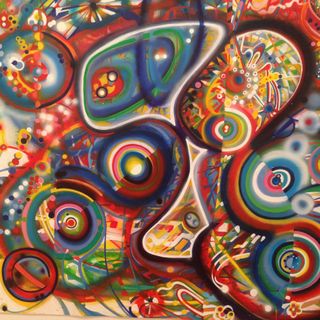
Detail 'Parallel universes' 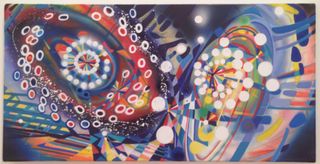
Andromeda and Milky Way - Airbrush, Ink on Canvas, 40 x 80 cm, 2015 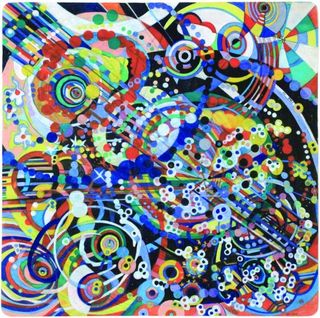
Time In - Ink, Woodstain on Paper, 60 x 60 cm, 2015


