

Speeding Through Space
About this exhibition
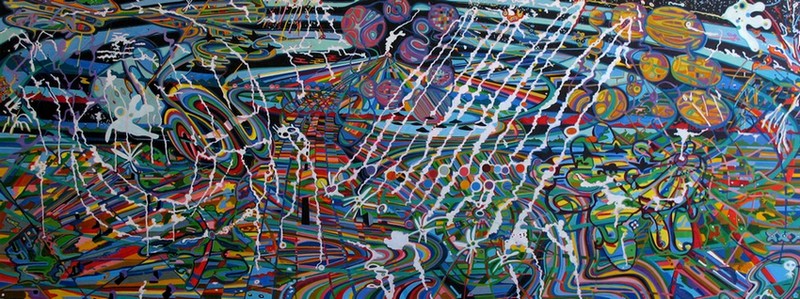
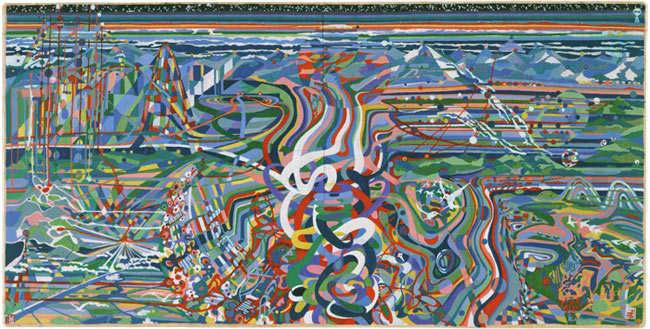
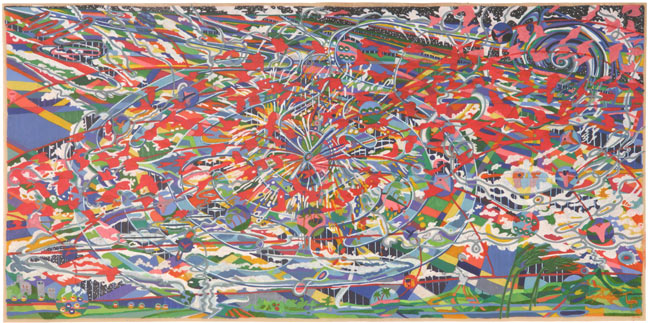
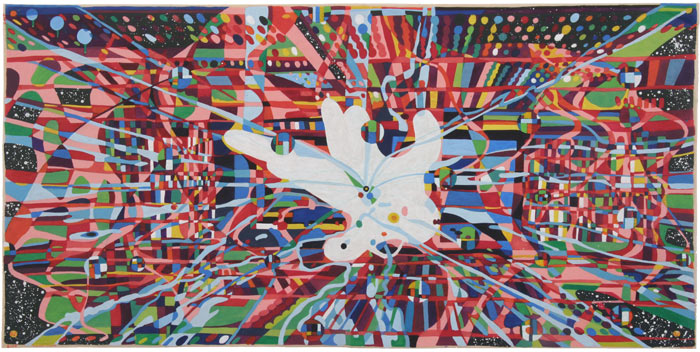
1. There is a great moment in Section 33 of Song of Myself when Walt Whitmanabruptly, imaginatively, and ecstatically blasts off into deep space,106 years before Russian cosmonaut Yuri Gagarin actually accomplishedthe feat in his spacecraft Vostok 1. Section 33 begins with the rousing,Einsteinian exclamation, "Space and Time!" which works Whitmaninto a state of heightened consciousness and boundless freedom: My ties and ballasts leave me, my elbows rest in sea-gaps, I skirt sierras, my palms cover continents, I am afoot with my vision. Afoot with his vision, Whitman then embarks on a hurtling tour throughAmerica, in a single, elastic sentence that stretches over four pages.In this sentence, Whitman constantly darts between city and country, Westernmountains and Manhattan's Broadway, rural homesteads and East Coast beaches,animals and humans. As he does so he notices and identifies with an amazingarray of American things: log huts, lumbermen, an alligator "in histough pimples," a Methodist preacher and a black bear, a Quaker womanand a "good game of base-ball," a quail and a bat, a hot airballoon and a wrecked ship, copulating livestock, a noisy printing press,a wrecked ship, herds of buffalo, Niagara Falls, fields of wheat and cotton,a moccasin print, shop windows displaying the latest wares, and geesewho "nip their food with short jerks," among many, many others.This cascading sentence is jam-packed with diverse information; it alsoanticipates all sorts of maximalists coming much later, who likewise packtheir paintings, drawings, sculptures, websites and texts with a densearray of images, information, and energy. Near the end of the sentence,Whitman steps outside at midnight into his backyard for a meditative momentand a breath of fresh air, but instead is instantly transported far awayand back into history, in fact to the origins of the Judeo-Christian tradition: Walking the old hills of Judaea with the beautiful gentle God by my side Exactly then, Whitman rockets from religion to science and science fiction;from past and present to a speculative future of space travel and exploration;from this world to a universe filled with splendors, immensities, andmysteries, when he finds himself: Speeding through space, speeding through heaven and the stars, Speeding amid the seven satellites and the broad ring, and the diameter of eighty thousand miles, Speeding with tail'd meteors, throwing fire-balls like the rest… 2. Flash forward to Ati Maier, and especially her stunning new painting Dérive,which is her first full blown painting on canvas in many years (she is principally known for works involving ink and wood stain on paper.) Thisacrylic and ink painting also involves "speeding through space," and "speeding through heaven and the stars," and when Whitmanmentions "seven satellites," a "broad ring," "eighty thousand miles," and "tail'd meteors" these could all bereasonable descriptions of exactly what one finds in the painting, although Maier hardly set out to work with Whitman in mind. The painting is a gorgeous, mind-bending conflation of things heavenly and earthly. Vivid, multi-colored planets pulsate andseem to shimmer and spin in the foreground; smaller, planet-like colorfulcircles drift about; and miniature mountains in the distance inexplicably sport tiny flags. A squadron of black flying saucers zooms in at an angle,while parti-colored farmlands, as if glimpsed from an airplane window,convincingly double as landing strips for the spacecraft of the future.More black flying craft, like a cross between the current space shuttle and futuristic airplanes, patrol the middle air. Two astronauts in whitespacesuits tumble and float at opposite sides of the painting. Light blueplanetary rings, which might also be curving energy beams, sweep throughthe painting's upper half, while jagged white bands cut across the pictureplane at an angle; they could be smoke plumes, strange clouds, or perhapsvisible electrical waves on an oscilloscope. Way up near the top, an inky blackness, signifying outer space, is festooned with glittering planetsand stars. At all points the earth, if indeed this is the earth, becauseit also seems like an alien planet millions of light years distant, isopen to and buffeted by cosmic forces in carnival colors coming from everywhich way. Maier's new (for her) technique of acrylic paint and inkon canvas results in a painting that is harder, more amped up, more outrageouslycolorful, and more filled with prominent surface activity than her acclaimedwork of the past several years. This brazen look and tough texture accentuatesthe painting's various tensions, and all its fractious cohesion. Wondersare articulated and Maier's fantastical mix of geography, geology, topography,physics, hallucination and intricate abstract patterning bedazzles andenthralls. Still, as much as this elaborate network holds together exquisitely,it also seems poised to burst apart into smithereens. There is somethingvery precarious here, and making things even more reeling and agitatedis how Maier juxtaposes and scrambles multiple perspectives. You lookdown at this painting, seemingly from a great height, as if from a spacecraftor through a satellite's camera. Shift your perspective an inch or soand you're looking horizontally at a distant horizon, and beyond thathorizon toward even more distant planets and stars. Shift your perspectiveagain and you're looking up, or in, or directly at, although you're alsoaware that urgent things are happening elsewhere, at the corner of youreye, or in a remote quadrant near the upper right hand corner, or at thelower left. This is a world you're always approaching, but never arrivingat, and also always leaving. This is a world that is bountiful, but alsosupremely unstable and chaotic. This is an exceptionally powerful paintingthat's also elusive and ungraspable. Moreover, while Ati Maier is clearlyinterested in "remote futures," to borrow Robert Smithson'sterm, it may be the case that her fanciful cosmic scene also has a greatdeal to do with life in our world right now, at a time when wavering hopefulnessabuts fierce strife, and when mounting fears of ecological mayhem makethe future seem especially unnerving.It may also be the case that Ati Maier's outer space paintinghas a great deal to do with intense inner space, with the shifts and twistsof the individual psyche, with flexible thoughts, nuances of emotion,and diverse to the point of wildly contradictory states of being. Thereis considerable boldness here, recklessness, and adventure. There arealso moments of beatific quiescence and repose. Parts of the work aresublime and others are frantic. There is playfulness and whimsy witnessseveral squiggly white shapes, with what look like bulging eyes and ridiculousgrins, which seem like a child's gleeful doodles. There is also worryand palpable danger. Almost all of Ati Maier's works are devoid of humanfigures altogether, along with other visible signs of the human, likearchitecture. What, then, does one make of the two hovering astronautswho seem very tender and vulnerable? They are partners, it seems, on somespecial mission, but something has gone wrong with the mission, and thereforethey are separate and adrift. 3. Ati Maier is a convincing pioneer of a new kind of ultra-mediated landscapepainting and drawing analog landscapes in a digital era of alternate realitiesand the Internet, virtuosic paintings chock full of information in a timeof information overload. It's absolutely correct that music, especiallysampling and electronica, is a potent influence on Maier. She is a knowledgeableand devoted aficionado of music, and the way she layers and combines diverseimagery, lays down repetitive patterns like beats and adds in samples andtangents, is very similar to how DJs construct their sonic adventures. It'salso correct that websites, videos, cartoons, comic books, and CD coversall factor into Maier's combinatory esthetic, along with NASA photographs,diagrams from books about physics and science, and probably dozens of othersources. With Sacré Coeur, a weightless astronaut in a white spacesuitis enmeshed in, or is perhaps emanating from her or his heart, a dizzyingmix of colorful forms, including snippets of landscapes, hints of computerwindows, pixelated patterns, scraps of language, and purely abstract designs.It's also right that whatever "nature" Maier presents is alwaysinfected and infiltrated by cultural forces. With Some Happy Day, a beleagueredtropical paradise, including bending palm trees and smoldering volcanoes,resembles a digital landscape in a video or a computer game. This ersatzparadise is being walloped by one of the weirdest storms ever, a whirlingassortment of jagged red bits, colorful grids that look like aerial farmlands,concentric rings and arcs that seem made of industrial material, clouds,wires, and balls which themselves contain mini-landscapes. This freak hurricaneresembles a cosmic storm, when galaxy clusters collide, or the aftermathof the Big Bang, and it is simultaneously creative and destructive. It is also fascinating to note that there are 19th century,and decidedly Romantic, underpinnings to Maier's 21st century esthetic,mostly having to do with a soulful, keyed up, and potentially ecstaticorientation to nature and landscape. The poet Walt Whitman and his greatinspiration, the poet, philosopher, and noted Transcendentalist RalphWaldo Emerson; European painters like J.W.W. Turner, John Constable, andCaspar David Friedrich; and American painters like Frederic Church andThomas Moran, among others, are precursors to Maier's eccentric visions.What Maier shares with them is an understanding that encounters with naturecan really have a mind-spinning power, can really induce reverie and awe,and can really be psychologically and spiritually transportive. What sheshares as well is an interest in artworks that aspire toward the ecstatic,cathartic, and the sublime. When I first met Ati Maier several years ago I was immediatelyentranced by her ink on paper works, which at the time were much smallerand sparer than her work now. Many of these works from the mid to late1990's are rooted in a Western United States landscape, complete withmountains, buttes, prairies, arroyos, escarpments, big distances, immenseskies, and occasional horses. As a child and a teenager in southern GermanyMaier became an expert horse rider and trainer an enthusiasm she has maintainedin the U.S. As often as she can, she travels to Wyoming, where she keepsher own horse, hobnobs with cowboys and cowgirls, and feels very muchat home with the horse culture there. On horseback, Maier also goes onsolitary excursions into remote regions, where she experiences the landscapedirectly and at length, a landscape that could not be more different fromthe Bavarian landscape where she grew up (or her adopted New York City,for that matter). Something about being alone, with horses, in regionswhere there are few if any other people, where the landscape is harshand spectacular, and where the sky is both huge and eventful, has beenespecially fruitful and liberating for Maier. Maier's personal excursionsand experiences also intersect with the history and mythology of the AmericanWest: all that largeness, all those horses, all that rugged individualism,all that freedom.It's interesting to note that horses, when they appearin Maier's work from this period, seem like holy creatures: wild, eventful,and wise. They've got an aptitude for adventure, and an antipathy to restriction,and the same goes for spacecraft, which appear in the skies, land on theground, and serve as ambassadors from remote planets where the rules areall different, and where the normal logic just doesn't apply. Most strikingof all is how Maier's (at the time) modest and vaguely plausible landscapesalso seem very strange, unearthly, and magical: dream landscapes, trancelandscapes, landscapes partly seen and partly hallucinated, landscapesoccurring on some distant planet that has no name yet. Maier's implicitorientation in these works is that of a traveler, or voyager, approachingmarvelous new lands with a mix of outright wonderment and quizzical investigation.She is an immigrant, filled with curiosity and alertness, but still anoutsider, and that is perhaps why her perspectives and sight lines areso unusual: she is always seeing things from afar, from odd angles, fromon high, from the top of a neighboring mountain, from the captain's seatin her own roving spacecraft. While her works have changed a great dealsince then they have gotten much bigger, more complex, and more panoramic,and they also increasingly occur in outer space altogether she maintainsthis orientation, this immigrant's perspective, gazing intently acrossgreat distances at things which are marvelous, but also bewildering andpeculiar. 4. Consider Maier's Another Country, which would look awfully interesting comparedwith any number of spiritually inclined paintings of the American West by,say, Thomas Moran, Frederic Church, and Albert Bierstadt. The view is ofa fertile, perhaps paradisial, wilderness valley way down below, along withsnow-capped peaks, a cloud-filled sky, and star-filled deep space in thedistance. One thinks of adventurers like Lewis and Clark, crossing the BitterrootMountains in Idaho, or the Mormons, after their great travails, advancingthrough Big Mountain Pass toward the Salt Lake Valley below. One thinksof the whole enduring ideology of a "promised land," borrowedfrom the Old Testament and imported to this country by the Puritans, forbetter or worse. One also thinks of Thomas Moran's great 1872 painting Grand Canyon of the Yellowstone, and Albert Bierstadt's 1863 painting In the Foothills of the Rockies both are paintings in which impressive geologic formationsassume almost mystical and spiritual powers. In Maier's hands such a Western idyll becomes a raucous,thoroughly contemporary hybrid: part representation of a "real"landscape, part representation of a virtual landscape, and part somethingconcocted entirely in her own imagination. Various colorful lights blinkfrom atop mountains and hills. Red, white, blue, pink, yellow, and greenbands wind through the land like rivers and canyons, and flap and driftin the sky like trailing pennants and streamers. Everything is imbuedwith plugged-in colors, and everything is spectacle, but a curiously thoughtful,even meditative spectacle, and that is one of Maier's great fortes: sheleaves room in her eye-popping works for both her and us to move in, anddream in. There are also ambiguities in this painting. It's tough to say,for example, whether we are being ushered into this new country, or whetherwe should reverse course and hightail it out of there forthwith. The words"Don't Look Back" hang in the air like especially precise skywriting,and offer both an exhortation to proceed confidently, and a warning toget out while you can. Then again Maier excels at such ambiguities. Herworks are precise and exacting, but also full of improvisation and subjectto alarming turbulence. Obviously afoot with her vision, Ati Maier's questingnew paintings and drawings are among her best and most ambitious worksyet. —Gregory Volk
Works
-
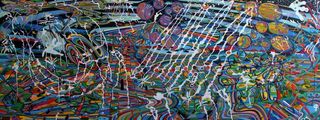
Derive -
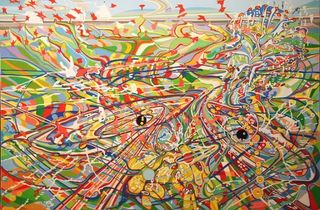
Whistle -
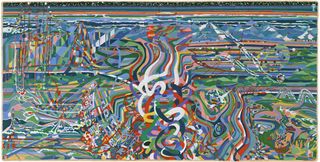
Another Country -
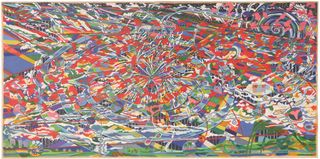
Some Happy Day -
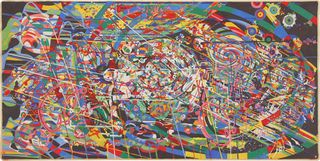
Oof -
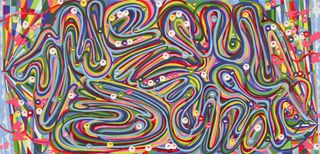
Twist -
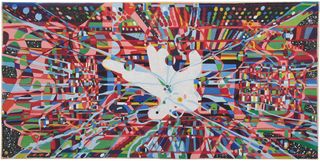
Sacré Coeur -
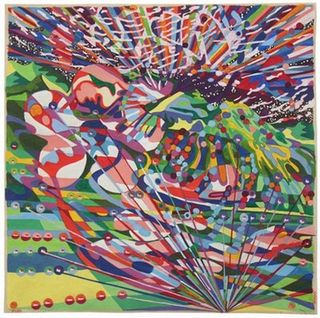
Push -
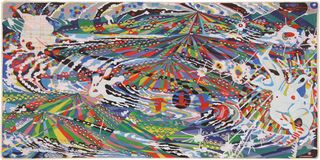
Year of the Dog -
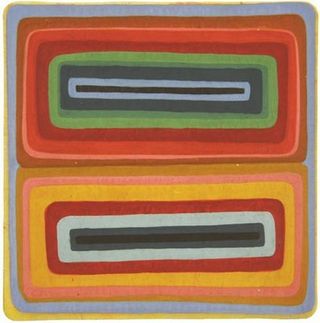
Eyes -
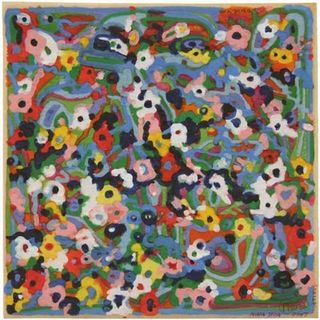
Mina Diva -
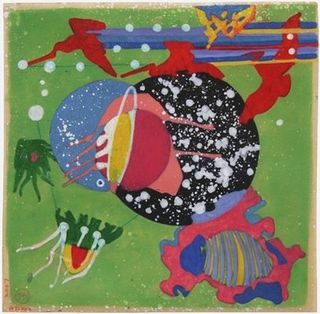
Green Mind -
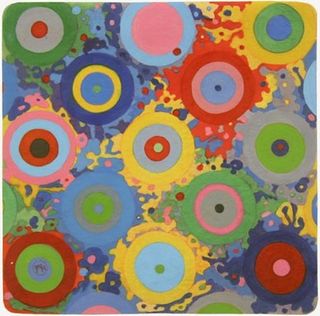
13 Circles
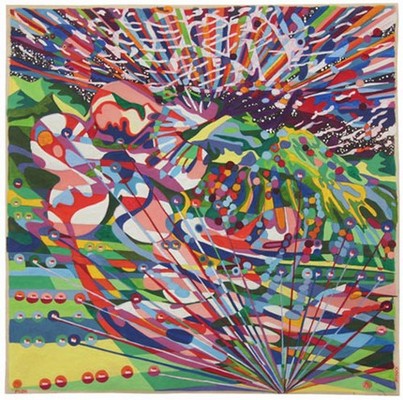
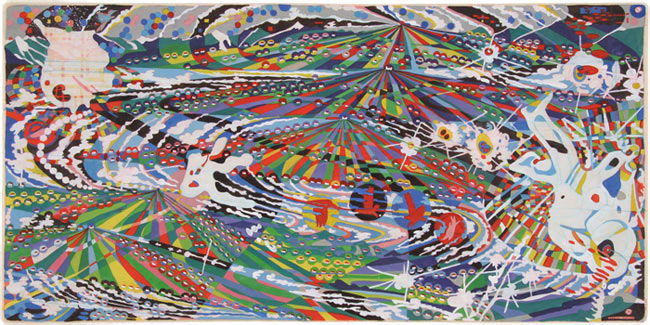
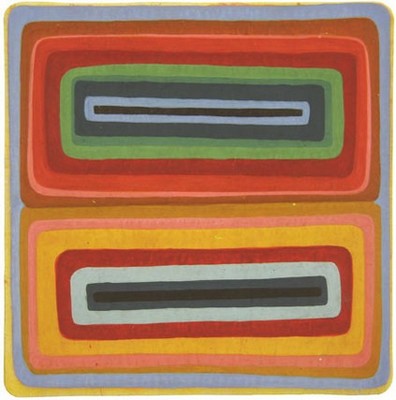
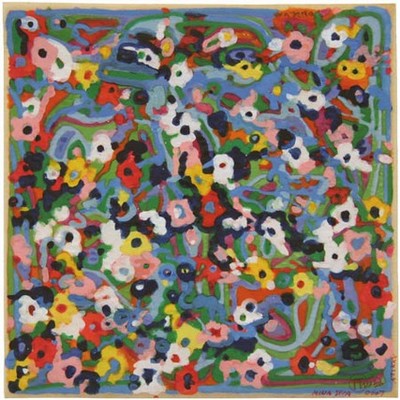
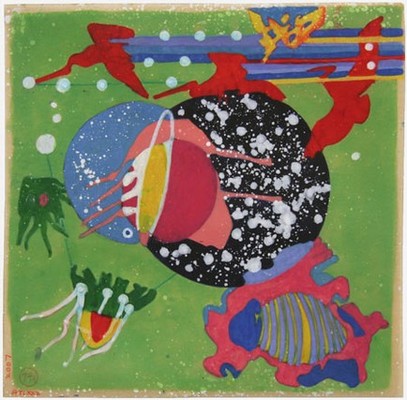
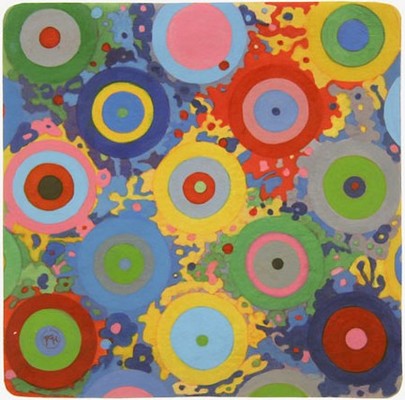
| No. | Image | Title | Medium | Dimensions | Year |
|---|---|---|---|---|---|
| 1 | Derive | Acrylic Ink on Canvas | 97 x 244 cm | 2007 | |
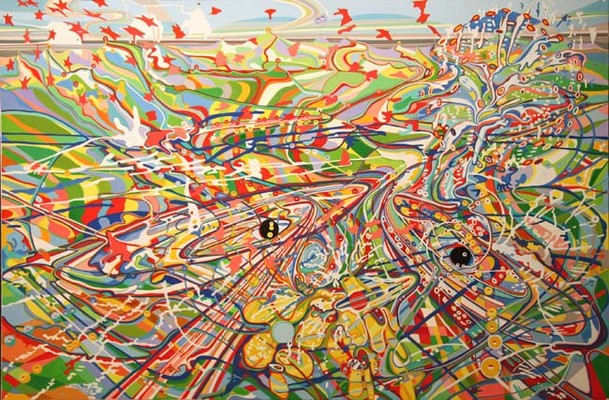
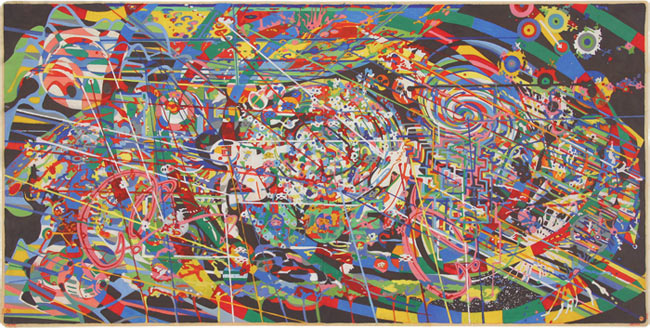
| 2 | Whistle | Acrylic Ink on Canvas | 183 x 122 cm | 2007 | |
| 3 | Another Country | Ink, Woodstain on Paper | 60 x 120 cm | 2006 | |
| 4 | Some Happy Day | Ink, Woodstain on Paper | 60 x 120 cm | 2006 | |
| 5 | Oof | Ink, Woodstain on Paper | 60 x 120 cm | 2006 | |
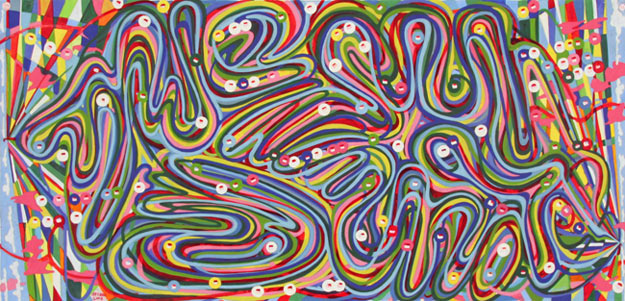
| 6 | Twist | Acrylic Ink on Canvas | 40 x 80 cm | 2006 | |
| 7 | Sacré Coeur | Ink, Woodstain on Paper | 40 x 80 cm | 2007 | |
| 8 | Push | Ink, Woodstain on Paper | 40 x 40 cm | 2007 | |
| 9 | Year of the Dog | Ink, Woodstain on Paper | 40 x 80 cm | 2006 | |
| 10 | Eyes | Ink, Woodstain on Paper | 20 x 20 cm | 2006 | |
| 11 | Mina Diva | Ink, Woodstain on Paper | 20 x 20 cm | 2007 | |
| 12 | Green Mind | Ink, Woodstain on Paper | 20 x 20 cm | 2007 | |
| 13 | 13 Circles | Ink, Woodstain on Paper | 20 x 20 cm | 2007 |


